
← Return to RECORDINGS
Kahlo Quartet:
After beauty
Release: Nov 01, 2026
Irreverence Group Music [IGM], in collaboration with the Kahlo Quartet, presents After Beauty, the world premiere recording of composer Julian de la Chica’s integral String Quartets, Op. 7, set to be released in Fall 2026. The album brings together String Quartet No. 1, “Hypnagogia,” and String Quartet No. 2, “After Beauty,” recorded for the first time as a complete cycle and marking the Kahlo Quartet’s debut studio album.
The origins of Op. 7 date back to 2016, when String Quartet No. 1, “Hypnagogia,” was premiered at Carnegie Hall, marking De La Chica’s debut there as both composer and pianist. Nearly a decade later, the composition of String Quartet No. 2, “After Beauty,” completed a cycle conceived across two distinct periods of the composer’s life. Rather than functioning as independent works alone, the two quartets form a continuous exploration of memory, repetition, silence, and emotional erosion. Moving between post-minimalism, psychological fracture, and moments of almost sacred stillness, the integral develops through recurring gestures, extended silences, and gradual harmonic transformations, allowing material to emerge, disappear, and return in altered forms.
Listen to Aria No. 3: El Arno
String Quartet No. 1, “Hypnagogia,” and No. 2, “After Beauty,”

-
Format: Album
Release: November 01, 2024
Catalogue: IGM-046
GTIN/EAN/UPC: 4068992221731
Producer: IGM
Commissioned by Rosario Armas & IGM -
Rosario Armas (Mezzo Soprano)
Ahmed Alom (Piano) -
Julián De La Chica
-
Julián De La Chica
(Based on four verses by Padre António da Ascenção) -
De La Chica — Arias Florentinas, Op. 15 & Canciones de la Muerte, Op. 20:
Arias Florentinas, Op. 15:
01. No. 1: El Soneto
02. No. 2: Sigilo de un beso
03. No. 3: El Arno
04. No. 4: El Sueño
05. No. 5: Las Calles de FlorenciaCanciones de la Muerte, Op. 20
06. No. 1: Peregrino
07. No. 2: Introspección
08. No. 3: Soberbia09.
09. No. 4: Quietud
10. No. 5: Epílogo: TransfiguraciónBonus Track:
11. La Llorona (Arr. by Ahmed Alom)
-
Commissioned by Rosario Armas & Irreverence Group Music
Produced by Irreverence Group Music
Music by Julián De La Chica
Lyrics by Julián De La Chica
(Based on four verses by Padre António da Ascenção)Rosario Armas - Mezzo Soprano
Ahmed Alom - PianoRecorded, mixed & mastered by Greg DiCrosta
at Firehouse 12, New Haven, CT
Edited by Julián De La Chica
at IGMLab Music, Brooklyn, NY
Performed on Steinway “D” Hamburg (CD-79)
Piano Technician: Timothy J. RobinsonAlbum Notes by Juan Lázaro
Artwork/Cover: IGM
Photography by Julián De La Chica
Videos by IGMJulián De La Chica’s music is published
by Vagabundo Music Publishing, Inc. (BMI)
Manufactured and marketed
by Irreverence Group Music (Brooklyn, NY)
Made in US. Total time: 53 min
Ⓟ & © IGM 2024

Album NOTES
By Juan Lázaro
After the Beauty: Julián De La Chica and the Solitude of Sound
It was in a dream that Julián De La Chica first saw his String Quartet No. 1. Lying half-awake, he imagined a rose blooming between two notes — a vision at once tender and unsettling. Those paired tones, close enough to ache, became the seed of the entire work. “The beginning is everything,” he says. “The rest is just development.”
That image — the fragile flower suspended between tension and release — has followed him ever since. It has become shorthand for the sound world De La Chica has built across his career: music born of solitude, pared down to its breath.
The quartet moves with glacial slowness, almost entirely without vibrato, as if afraid to disturb the air. Its five cycles — De La Chica avoids the European term “movements” — trace the passage from the rose’s first bloom to its inevitable decay. The music asks for stillness rather than display, for silence to carry part of the meaning.
The score itself reads like a credo: “without vibrato,” “minimum weight on the bow,” “austere sound. Minimal. Worn. A resigned sound.” These are not performance directions so much as a moral stance — a sound world stripped of ornament, where fragility becomes truth. “It’s not about beauty,” De La Chica says. “It’s about what comes after the beauty — when the flower dies.”
Beneath the calm surface runs quiet extremity: long tones stretched to the edge of breath, harmonies balanced between consonance and collapse. Where others polish away imperfections, De La Chica invites them in. “I like the rawness,” he says. “Reality is life, and now it’s dying. You need to feel that in the sound.”
His insistence on near-vibrato-less tone inevitably calls to mind the inward gravity of Beethoven’s late quartets — above all the Heiliger Dankgesang, where stillness and fragile intonation become a kind of devotion. De La Chica’s sound, though born of a different century and a different landscape, shares that same sense of vulnerability turned into spiritual pressure.
String Quartet No. 1 was born in 2015 from an invitation to write for a Carnegie Hall event connected with musicians in the Philip Glass circle. “The quartet is such a responsibility,” he recalls. “It’s a sacred form.” The composer immersed himself in lineages that stare directly into silence: the late Beethoven quartets, Shostakovich’s Fifteenth, Glass’s Dracula, and Haydn’s The Seven Last Words of Christ, whose meditative restraint helped shape his own sense of how sound can hold stillness without going cold. The dream of the rose gave him his entry point — beauty already shadowed by its ending.
When the piece premiered, De La Chica felt both satisfaction and distance. The work had revealed itself, but not yet its time. He and the original players tried to record it, but the studio sound wasn’t what he was hearing internally. “It wasn’t ready,” he says. “The sound wasn’t what I heard inside.” He would wait nearly a decade for the right performers.
A Voice Beyond Borders
De La Chica’s search for sound began long before that dream. Born in Manizales, a mountain city in central Colombia, he began studying piano at the age of five. The conservatory path offered promise but also confinement. “You have a lot of noise in your mind when you leave the conservatory,” he says. “All those patriarchal ideas of what music should be. But I was missing my own voice.”
He left before graduating and began to travel — across Europe, then back through Latin America — earning the nickname el vagabundo del piano, the piano vagabond. De La Chica lived by playing, teaching, improvising. More importantly, he learned how to listen again. “It was about unlearning,” he explains. “About silence. About finding the moment when music begins inside you.”
By 2010, the composer had relocated to New York City, working day jobs while composing in a small Harlem apartment before later making his home in Brooklyn. At night he wandered. From his window he’d watch a lone figure at the corner bodega, or the pulse of lights on the elevated train. “You hear a kind of counterpoint in the city,” he says. “Every sound belongs to another rhythm.” That landscape of overlapping noise and loneliness became his true conservatory.
Out of that world came Poemas de Bar (2010), a cycle of Spanish-language songs about strangers glimpsed through the haze of bars and subway platforms — anonymous lives brushed by music. “New York is so full of people, but it’s a very lonely place,” he has said. The work lay dormant for a decade before finding its voice through mezzo-soprano Yana Mann during the pandemic. Its belated rebirth mirrored De La Chica’s belief that some works have to wait to become what they are.
At the same time, his creative reach widened. He made films (Agatha, The Experiment), wrote Preludes for Lisa Moore, and composed electronic works like Voyeuristic Images. He shot photographs, wrote poetry, scored soundtracks. “I don’t believe anymore in these divisions,” he says. “When I feel I need to use a camera or a piano, I just do it.”
On his own site, De La Chica has described his aesthetic in almost existential terms. People call it “minimalism,” but he pushes back: for him, the so-called minimal is not a style, it’s a way of being. He writes about listening at night to “the noise of my fears,” and about discovering, as a child, “that unusual place where the minimal resides.” In other words: what some hear as reduction, he experiences as exposure. His music doesn’t decorate emotion. It reveals it.
That credo runs through all his work. Whether through camera, keyboard, or quartet, De La Chica listens for the instant when sound becomes presence.
Two Quartets and a World Between
If String Quartet No. 1 reflects inward, its successor faces the world’s disarray. Composed in 2017 without commission, String Quartet No. 2 arrived during a period of exhaustion — personal, political, planetary. “Everything felt hopeless,” he recalls. “It was like watching our self-destrction in real time.”
Where the first quartet moves through cycles of birth and decay, the second starts amid ruins and simply refuses to pretend. Its structure is skeletal: silence dominates, and the few bursts of motion feel fevered, almost panicked, as if the music were trying to outrun collapse. “Maybe it’s not darker,” De La Chica says. “Maybe it’s just realistic.”
Yet even within its severity, there’s tenderness. The music moves at the rate of thought rather than pulse. Its fragility is its strength. De La Chica describes silence here as “a new luxury” — something rare, almost endangered — and the quartet is full of pauses that force you to experience that luxury. “We live surrounded by noise,” he says. “Real silence has become rare — and radical.”
De La Chica’s process demands the same radical honesty from the performers. He writes in extremely slow tempos, asking the players to sustain long notes with almost no vibrato, perfectly aligned. On paper it looks simple; in the body it’s punishing. The goal isn’t prettiness — it’s exposure. The composer even told the players, bluntly, that the sound must feel exhausted — that there should be “no hope” left in it. The quartet’s surface austerity isn’t an aesthetic stunt. It’s an ethical stance.
Around this time De La Chica wrote Summa, for string quartet and keyboard — a meditative counterpart inspired by Thomas Aquinas’s Summa Theologica. Summa sits alongside the two quartets like a reflective coda. Here, he folds in the electronic and recorded sounds that are also part of his voice. “The keyboard gives breath to the strings,” he says. “It opens another dimension, like the spirit that moves inside the sound.”
Taken together, these three works form a kind of triptych: life, aftermath, and reflection. The first quartet traces the interior landscape; the second, the world’s fractured mirror; Summa gathers what remains into stillness. They are concise but unhurried, existing in a suspended present tense. In De La Chica’s world, silence isn’t absence — it’s the field in which sound becomes visible.
After the Beauty
De La Chica’s relationship with time is patient, almost devotional. He doesn’t rush a piece into the world. Some projects, he says, announce when they are ready — and until that moment, he holds them back. The quartets waited nearly a decade for that moment.
Several ensembles had approached him about recording the quartets, but none quite lived inside the sound he imagined. He talks about how difficult it was to find a quartet “in the middle”: not a purely canonical Beethoven/Shostakovich machine, not an aggressively experimental noise unit, but a group that understood color, pacing, and silence as living material.
That someone turned out to be the Kahlo Quartet, a New York–based ensemble whose members — Audrey Lee (United States), Manuela Romero (Cuba), Freddy Contreras (Venezuela), and Andrea Beltrán Landers (Peru) — share a mission of bridging the classical canon with the musical voices of Latin America. What mattered to De La Chica wasn’t only their programming identity but their attitude toward sound. He felt they approached the music more as philosophy than mere “performance.”
They recorded the complete cycle at Firehouse 12 in New Haven, a studio known for its intimate acoustics and unforgiving honesty. The session began before dawn and ran deep into the night — roughly 6 a.m. to almost 10 p.m. On the page, the music looks simple, but, as De La Chica remarks, “it’s so naked — very naked,” with only a few touches of vibrato allowed. The musicians repeated entire cycles to chase a precise tension between focus and fatigue.
By evening, the players were physically spent from sustaining those exposed, slow tones, and that exhaustion itself became part of the sound he wanted. De La Chica often stopped them earlier in the day when the playing sounded “beautiful,” asking instead for less polish, more surrender — until the music reached the hopeless, exposed atmosphere he had imagined on the page.
In that sense, the recording documents not just two scores and a coda, but a way of playing. It captures what the composer calls the “rawness” — the reality of something alive and already dying.
Hearing the two quartets together, one senses candor rather than despair. The first begins with birth and ends in dissolution; the second begins already amid ruins. Yet both carry the same quiet endurance — the sense that continuing to sound at all is itself an act of resistance.
De La Chica’s influences — Shostakovich’s inward gravity, Beethoven’s spiritual courage, Haydn’s restraint, Glass’s luminous patience — are all refracted here. But his own path diverges from all of them. Minimalism often builds motion; he pares it away. Romanticism swells; he lets it fade. These quartets inhabit the liminal space between expression and disappearance, faith and fatigue.
For De La Chica, the music decides its own timing. Some works wait for years — quietly — until the performers, the context, even the world itself are finally ready for them.
That belief shapes everything he does. Poemas de Bar waited ten years for its singer; these quartets waited for their players. His films and preludes evolve by seasons rather than schedules. Patience, for De La Chica, isn’t delay — it’s devotion.
And so these quartets feel less like new compositions than rediscoveries: sounds that were always there, waiting for their moment to be heard. They invite us to slow down, to notice the fragile grain of sound, the way silence holds it. Before the first note, the stillness of the hall already feels charged. The audience leans forward, uncertain if the music has begun. When it ends, that same stillness remains — transformed, resonant, full.
Two notes tremble in the dark. Between them, the rose opens once more — beautiful, dying, and utterly alive.

City of Florence
By Julián De La Chica
The Arias Florentinas were composed in the summer of 2021 during De La Chica’s travels to Florence in a post—pandemic world. Italy’s emptiness in the summer—a stark contrast to its usual bustling nature—served as inspiration. While wandering the city’s streets, De La Chica discovered a concert poster featuring a Portuguese soprano performing Italian arias in a small chapel. He attended, and the experience of returning to live music after more than a year of isolation, combined with the traditional repertoire and the magic of that night, compelled him to immediately compose the song cycle. "That night, those arias sounded like never before," he recalls. "We take everything around us for granted until something like a pandemic makes us realize our fragility.”
The texts from the arias are conventional, casual conversations of everyday life. De La Chica jotted down fragments of conversations overheard throughout the city, transforming himself into a troubadour who stitched them into passionate songs. Through Rosario Armas’s voice, which ranges from the intimate to the stentorian, these cycles coalesce into a narrative of suspense, love, suicide, and acceptance.
In Arias Florentinas, Armas employs the full breadth of her vocal register, skillfully transitioning from lower, Verdian mezzo tones to the gentleness of bel canto legato. Her mastery echoes the golden—age singers as she seamlessly navigates the range required to conclude with Las Calles de Florencia, a leisurely andante that reflects De La Chica’s contemplative stroll through the city, cleansing the emotional palate as the cycle ends.

The Capela dos Ossos
Photo by Julián De La Chica

The Capela dos Ossos
Photo by Julián De La Chica
Suddenly, the atmosphere left by the arias—concluding with a seemingly inconclusive piano C-flat note—shifts as the stroll transforms into a pilgrimage with El Peregrino from Canciones de la Muerte, Op. 20. A brief but shocking display of virtuosity from pianist Ahmed Alom abruptly transports the listener into the realm of death. While the cause is unknown, it is clear that this is not a peaceful transition.
Canciones de la Muerte were written and dedicated specifically to Rosario Armas after numerous collaborations between her, De La Chica, and Alom, following their work on Alom’s debut album Exilio, which included Adiós Cuba, a piece composed by De La Chica in 2008. Their first single was Soledad, followed by Armas’s first EP Mandala (texts by Susan Campos Fonseca). Impressed by Armas’s voice, De La Chica envisioned this collaboration long before visiting Évora, Portugal, where he realized, “This cycle must be for Rosario. No one else could bring that darkness and conviction.”
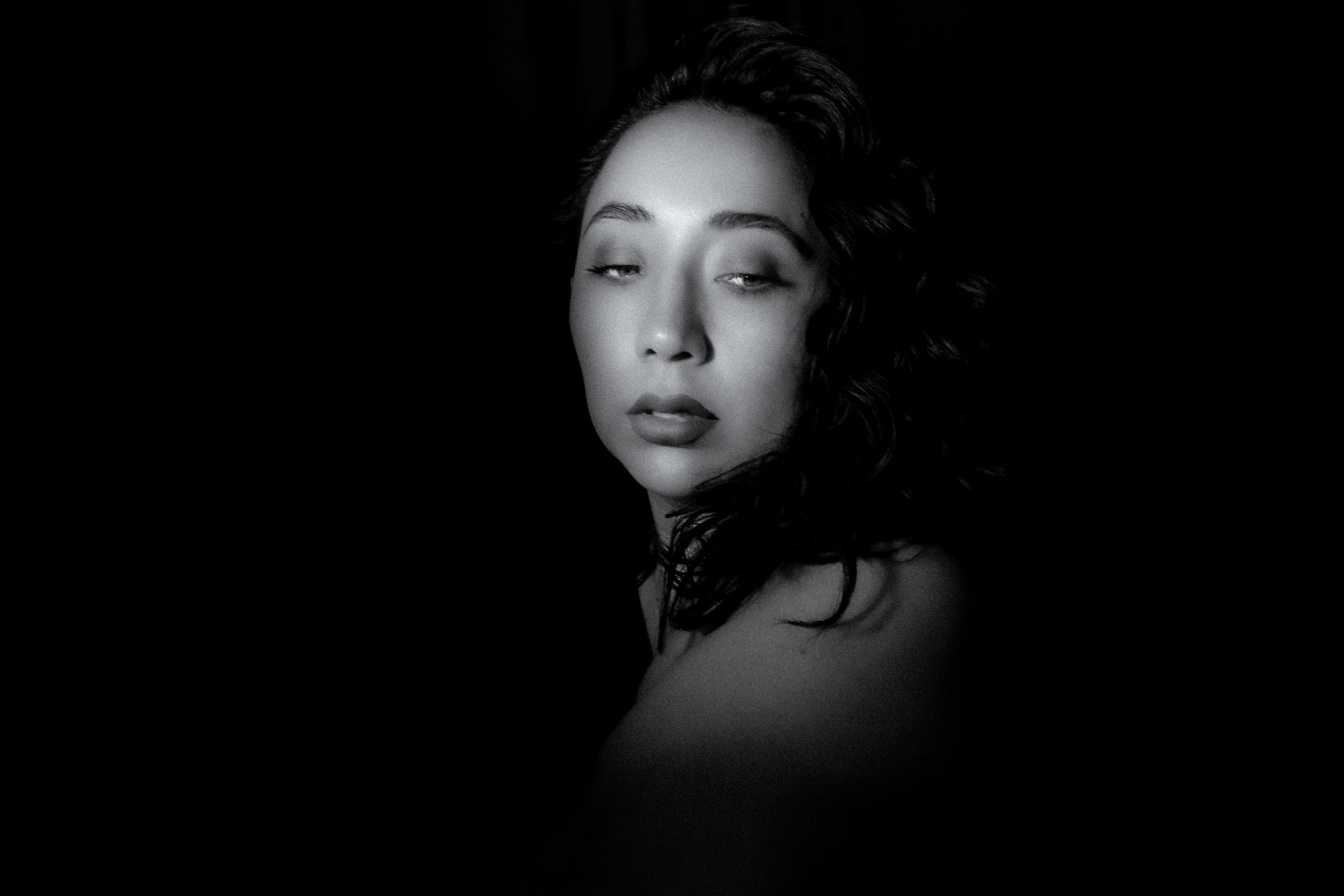
Take 46. Ritual. Exercise I.
Based on Canción De La Muerte No. 1: Peregrino
The cycle was composed in the summer of 2023 during De La Chica’s first visit to Évora, where he visited the Capela dos Ossos (Chapel of Bones), constructed from human bones. Nestled within one of Évora’s squares, this austere chapel left a deep impression on De La Chica. The simple, clear, and minimalistic verses inscribed inside, attributed to Father António da Ascenção, reflect on the fragility of life and death.
These four verses, along with an additional verse by De La Chica (Canción de la muerte No. 5: Epílogo, transfiguración), explore the acceptance of mortality. De La Chica translated them into Spanish to maintain a consistent phonetic flow with the arias. As a composer drawn to themes of death and spirituality, De La Chica returned to his earlier works, particularly his song cycle Op. 9: Experimentelle und Unbestimmte Lieder, where he first explored existential concepts.

Take 43. Introspection. Exercise IV.
Based on Aria No. 3: El Sueño
The opening piece of Canciones de la Muerte begins with the text (original in Portuguese): “Aonde vais, caminhante, acelerado? Pára...não prossigas mais avante; Negócio, não tens mais importante, Do que este, à tua vista apresentado.” (Where are you going in such a hurry, traveler? Pause...do not advance your travel. You have no greater concern than this one: That which is now before your eyes.) De La Chica masterfully conveys this “pause” with dark, heavy chords, followed by a virtuosic piano passage that mirrors the hurried pace of everyday life.
In this cycle, Armas delves into the solemnity of death’s arrival, exploring the layers of human emotion that accompany the end of existence: fear, acceptance, and transcendental peace. Interwoven with De La Chica’s own verses, La Canción de la muerte No. 4: Quietud and No. 5: Epílogo: Transfiguración expand on the death marches of Chopin’s Sonata No. 2, the voice of death in Schubert’s Der Tod und das Mädchen, and Mussorgsky’s Songs and Dances of Death. In Quietud, death emerges as a teacher, laying bare the inevitable truths we must all face. In Epílogo, Armas unleashes the full power of her voice, concluding with a final burst of energy as our traveler raises their fist one last time before Death gently leads them into the unknown, accompanied, as De La Chica notes, by unexpected dark and clandestine clusters from the piano that evoke the uncertainty of what awaits us.
Take 22. Duda. Exercise V.
Based on Canción De La Muerte No. 5: Epílogo

In a surprising turn, and as a bonus track, Rosario—who is Mexican—ends the album with a heartfelt rendition of La Llorona, arranged by Ahmed Alom. More than just a lament, it becomes a love call to what so many fear. “La muerte,” Armas notes:
[La muerte] doesn’t overwhelm in this minimalist approach; instead, it creates spaces for contemplation, where silence is as significant as sound. This is an album that asks listeners not to fear death, but to sit with it, observe it, and find solace in its mysterious, inescapable nature.
The album ultimately guides us through a language of whispers and fragments. If we listen closely, we may hear the stories of unknown people. Whether they come from the living or the dead, however, remains a mystery best left to the imagination.
About the author
Juan Lázaro is a New York-born pianist of Peruvian and Russian descent. He serves as a Spanish coach and assistant conductor at the Metropolitan Opera of New York. Lázaro holds a bachelor's degree from the Juilliard School and a master's degree from the Manhattan School of Music. He has completed the first year of his Doctor of Musical Arts at the Manhattan School of Music.
BTS | Interview
Takes 35, 09
Retrospection. Exercise I.
Based on Arias No. 1: El Soneto

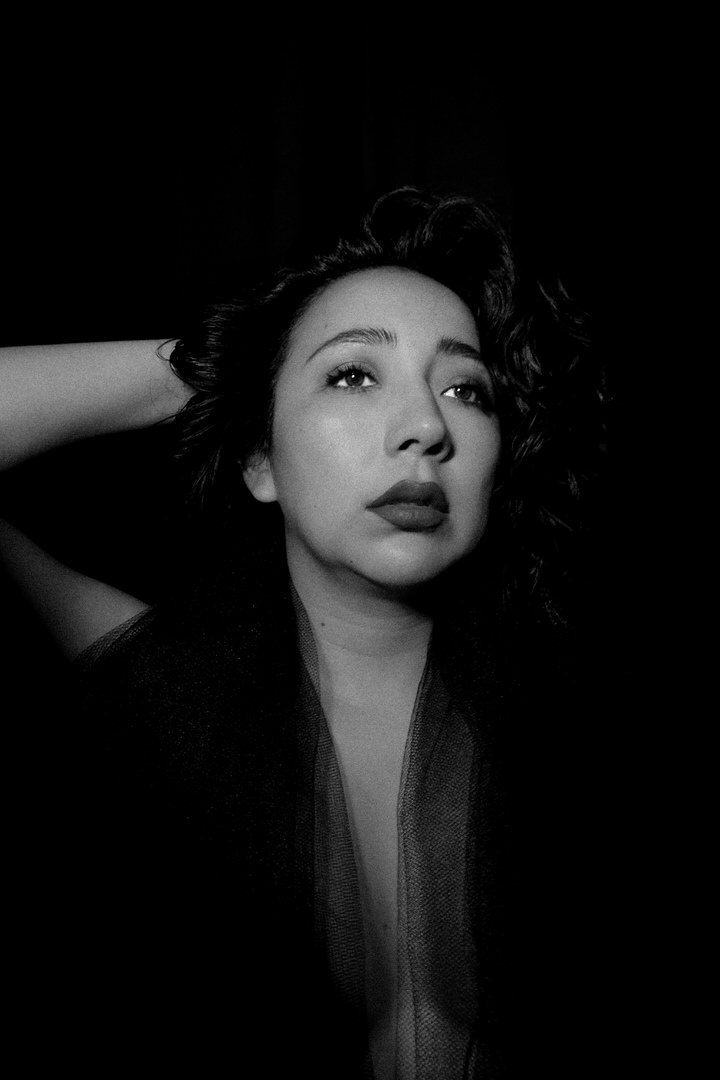
Take 46. Soberbia. Exercise II.
Based on Canción De La Muerte No. 3: Soberbia

Rosario Armas
Photo by Julián De La Chica