
Lavinia Meijer: A Force of Nature at the Harp
← Return to EDITORIAL
From Philip Glass to Julián De La Chica, the internationally acclaimed harpist discusses artistic independence, musical transformation, and the recording of Fado.
Lavinia Meijer is among the most significant harpists of her generation. A Sony Classical recording artist whose career has challenged the conventional boundaries of her instrument, she has brought the harp into musical territories rarely associated with its traditional repertoire. Her recordings have achieved remarkable commercial success, including three consecutive albums reaching the Top 10 of the Dutch rock album charts—an extraordinary distinction for a classical musician.
● Read more: A colorful journey in black and white, Juana Luna’s New Album: Canciones en Blanco y Negro
Her international career has taken her to some of the world's most prestigious stages, including Carnegie Hall in New York, the Concertgebouw in Amsterdam, the Musikverein in Vienna, the Berlin Philharmonie, and the Cité de la Musique in Paris. She has collaborated with leading orchestras and contemporary ensembles, continually moving between classical traditions and the experimental possibilities of new music.
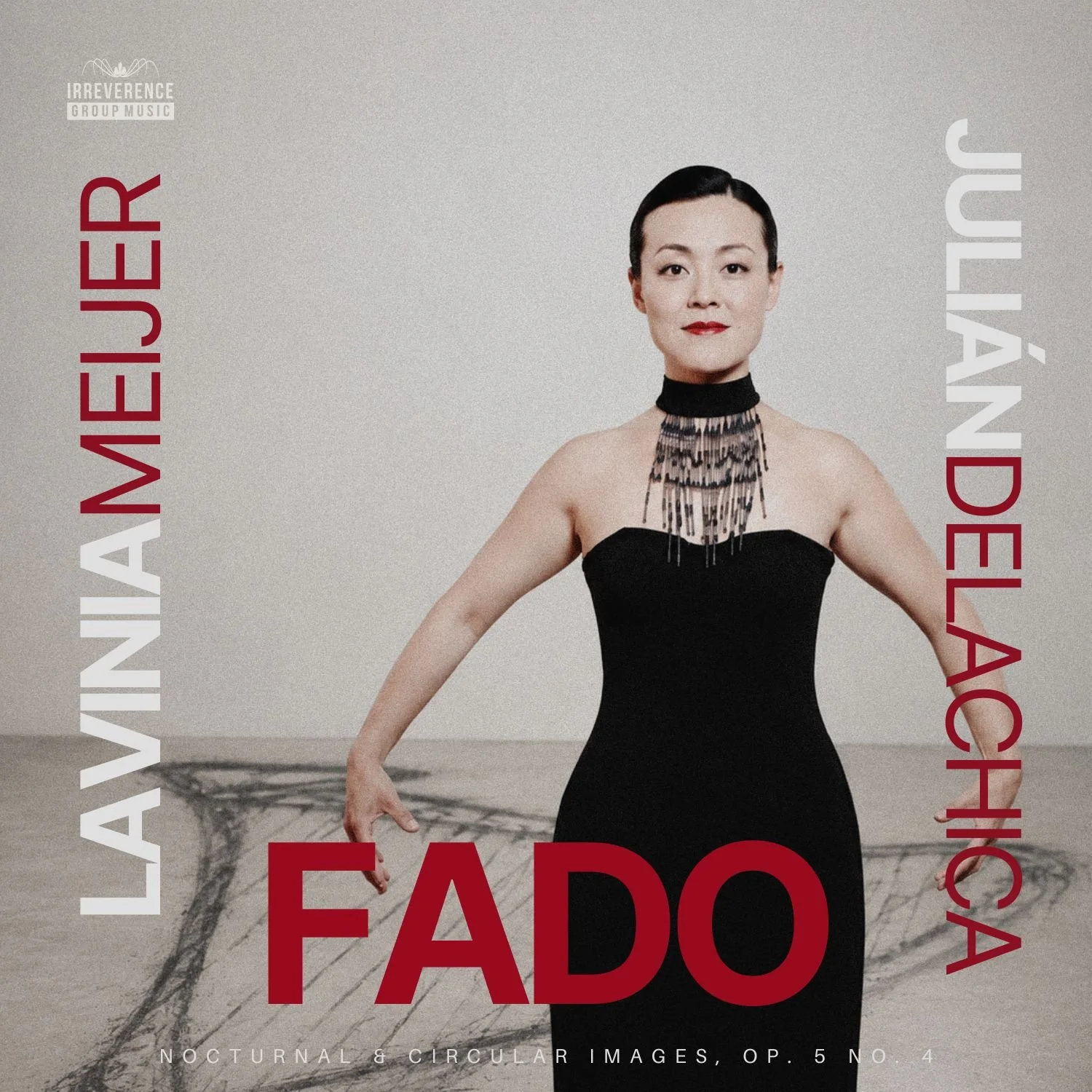
Tracklist:
01. Nocturnal & Circular Images, Op. 5, No. 4: Fado
The single is released by IGM
BUY & STREAM
Yet Meijer's artistic identity extends far beyond virtuosity. Her performances possess a distinctive theatrical and physical dimension: the harp becomes not simply an instrument to be played, but an architectural presence around which sound, movement, and silence unfold. Her approach to the stage resists the decorative associations historically imposed upon the instrument, replacing them with an intensely personal language of concentration, endurance, and expression.
Central to that evolution has been her longstanding artistic relationship with Philip Glass. Since meeting the American composer in 2011, Meijer has become an important interpreter of his music, bringing his repetitive structures, shifting harmonies, and demanding physical discipline into the world of the harp. Their collaboration has helped redefine the instrument's possibilities within contemporary classical music, demonstrating how familiar compositions can acquire an entirely different identity through transcription and performance.
It was also through the world surrounding Glass that another artistic relationship began.
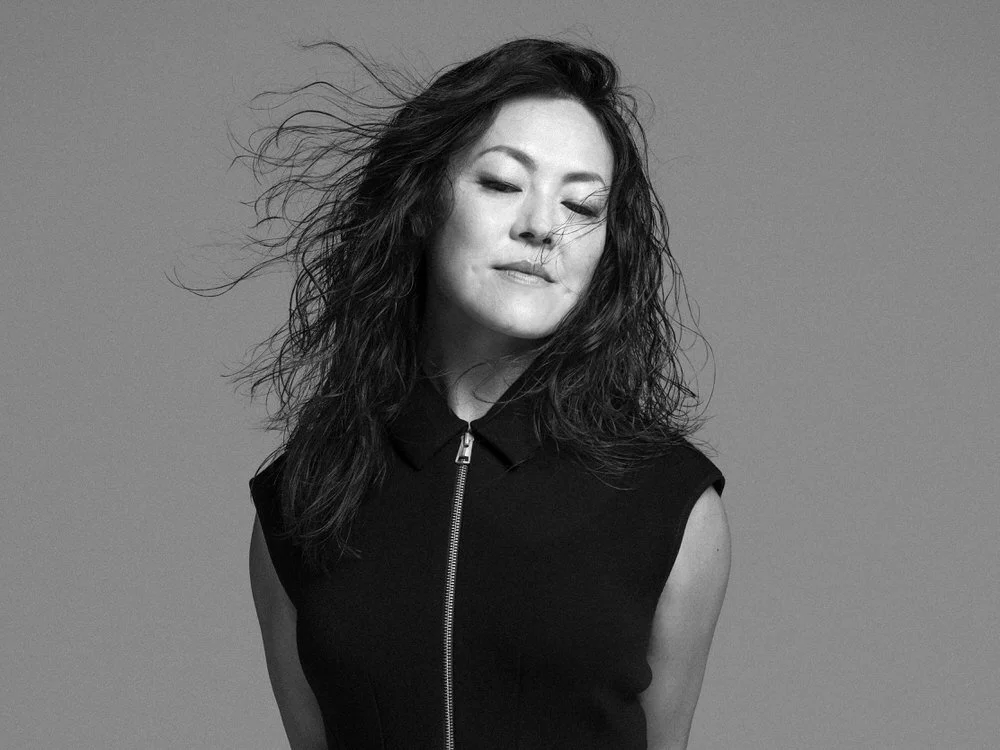
Lavinia Meijer. Image via NPR.
In 2016, Meijer met Colombian-born composer and filmmaker Julián De La Chica in New York, during the annual Philip Glass Gala following the Tibet House Benefit Concert at Carnegie Hall. Their paths would cross again in Brooklyn in 2024, following one of Meijer's performances at Public Records. What began as a meeting between two artists with a shared interest in contemporary musical expression gradually developed into a new collaboration.
During a later visit to De La Chica's home, Meijer heard the composer perform Fado, a work originally written for piano in 2014 as part of his cycle Nocturnal & Circular Images, Op. 5. Drawn to its restrained musical language and emotional intensity, she decided to bring the composition into her own repertoire.
The resulting recording, released by Irreverence Group Music on September 4, 2026, was subsequently selected for Spotify's editorial playlist New Classical. Meijer's interpretation also accompanies the closing sequence of De La Chica's film PIRET, extending the collaboration beyond music and into independent cinema.
To mark the release, IGM Editorial sat down with Meijer to discuss her remarkable career, her relationship with Philip Glass, the art of transcription, and her encounter with the music of Julián De La Chica.
Q&A with Lavinia Meijer
Hi Lavinia! How are you? Thanks so much for taking the time to answer a few questions for IGM Editorial.
1. IGM: The harp, one of the oldest instruments in Western musical history, has long been associated with beauty and delicacy. What did you want to change about the way we hear it?
Lavinia Meijer: Yes, the harp is one of the oldest instruments, dating from before 3000 BC, serving as a musical companion in many ceremonies and for troubadours. When I was 11, I got a new teacher, Erika Waardenburg, who had a great affinity for contemporary music, so from a young age I started playing modern classical music.
This led to the discovery that the existing harp repertoire was quite limited. You couldn't compare it to the many compositions written for instruments such as the violin and the piano. And why couldn't it be more appreciated as a solo instrument, like the violin and piano?
From the age of 15, I set myself a personal goal: I wanted to reach a wider audience, to show all the possibilities of the harp as a solo instrument, and to prove that it was more than what most people thought it was.
For the harp to develop with time, new music is essential, and I started asking composers to write for the instrument.
2. IGM: At what point did you realize that your career would require inventing your own path?
L.M: After my conservatory studies in Amsterdam, I followed a coaching course to find out which path I wanted to take.
The coach asked me what my goal was, and I thought back to when I was 15 and had shaped my personal ambition. I told him that I wanted to reach a wider audience, show all the possibilities of the harp as a solo instrument, and prove that the harp was more than what most people thought it was.
He laughed and said it was a cute girl's dream, but that with this goal I would not make it in the harsh music world. I needed to specialize in one style, for example only Baroque music, in order to stand out.
I then knew that this was something I definitely didn't want to do, so in a way it strengthened my sense of purpose and focus.
I was also lucky to have a mother who is an accountant. When I was 16, she helped me become an independent entrepreneur. I started asking programmers if they were interested in presenting a solo harp recital. It took time to convince them, but when I received more media attention, more and more invitations came in.
In a way, I want the harp to become as famous as the piano—but actually not that famous, because then it wouldn't be so unique anymore! A “popular niche” sounds good.
3. IGM: What did Philip Glass's music reveal to you about the harp—and about yourself as a musician?
L.M: When I met Philip Glass in 2011, I had never played so-called Minimal Music before. I had to work with more “distilled” material and therefore create “more with less”—not to be confused with less virtuosity; his music can be very tough on the muscles!
To me, the music of Philip Glass represents life itself—the light moments and the dark ones, all of it. Listening to his music, I feel as though I can die and be reborn.
My appreciation for his music—and for the man himself—has only grown since I got to know him personally. He is someone who has remained firmly grounded, always curious, and surrounded by a wonderfully diverse circle of friends, ranging from artists to scientists.
He wakes up at six every morning: first Tai Chi, then composing, followed by his appointments. It is an enviable level of discipline. His life is music.
Philip Glass is a true inspiration to me; his music holds a special place in my heart, and I'm very happy that Philip has trusted me with arranging his music for the harp.
4. IGM: Glass's music demands extraordinary concentration and endurance. How has it changed the way you perform?
L.M: In the beginning, there were quite a few moments when I lost track of where I was in the music. It had a hypnotizing effect on me.
It was like finding one's way through a neighborhood where all the buildings look the same—entirely different from an area where every street has a unique appearance.
I had to search for subtle reference points to store in my memory—doors or window frames that had a slightly different shape or color.
I also had to train my muscles differently. I kept having muscle cramps in one particular muscle in my right forearm. By massaging and strengthening this muscle—which I now call the “Glass muscle”—I was able to build the endurance and strength needed.
5. IGM: When does a transcription become a new work of art?
L.M: For me, there has been one rule when making a transcription: it should sound as though it could have been written by the composer for the harp in the first place.
Therefore, I also approach it as a harp piece, which can sometimes add new sounds to the original.
I like that kind of creativity, because playing it on the harp should have an added value.
6. IGM: How did recording Julián De La Chica's Fado connect with your own musical journey, from your early years with the folk harp to the classical stage?
L.M: For me, the harp is like a womb, which you can embrace physically from the outside, sitting behind it, but while playing it you are drawn inside, as if you're returning to your purest emotions.
And it is an instrument for everybody, but throughout the last couple of centuries in Europe and North America, the harp also became an instrument of the elite, especially for upper-class women, to play during family gatherings and for possible wedding partners.
I started playing the folk harp when I was nine. Then, after two years, when I was “discovered” as a young talent, I switched to the classical concert harp and studied a lot of virtuosic music. Soon, I had neglected my folk harp past.
Playing Fado, I feel that I can connect the harp with every style, and that it reaches out everywhere.
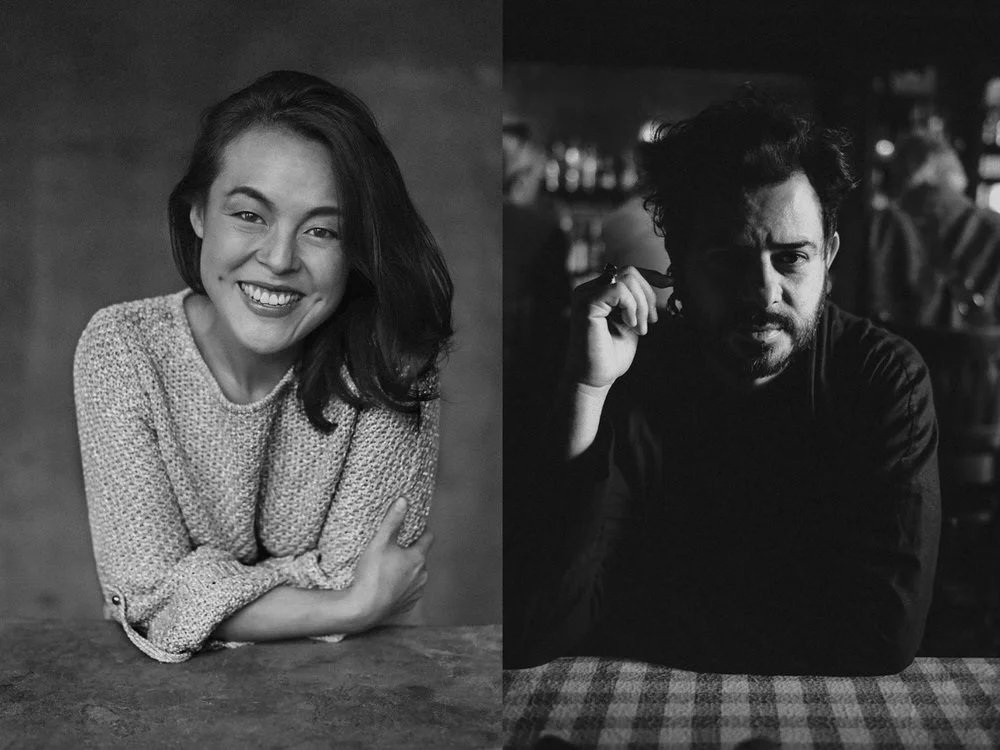
Lavinia Meijer by Stephan Vanfleteren & Julián De La Chica by Anyelo Troya
7. IGM: Fado was written for piano, almost with the Portuguese guitar in mind. What happened when you brought it to the harp?
L.M: The harp can create a lot of colors and sometimes sound like a guitar, or a piano, or a woodwind instrument, and many more.
The overtones created on the harp make it sound multilayered to my ears, as though one voice is singing it, or several voices.
8. IGM: Your recording of Fado closes De La Chica's film PIRET. What changes when music becomes part of a cinematic narrative?
L.M: It is wonderful! That is the power of music: it is invisible art, and by performing it in different settings, each time it brings another enrichment to its surroundings.
9. IGM: A Colombian composer, a Korean-Dutch harpist, a Portuguese musical tradition. Does music still belong to a particular place?
L.M: That is also the power of music: it travels across borders, like clouds and air.
I'm very happy my musical journey has led me to meet Julián De La Chica. When there is mutual respect, trust, and curiosity, so much is possible!
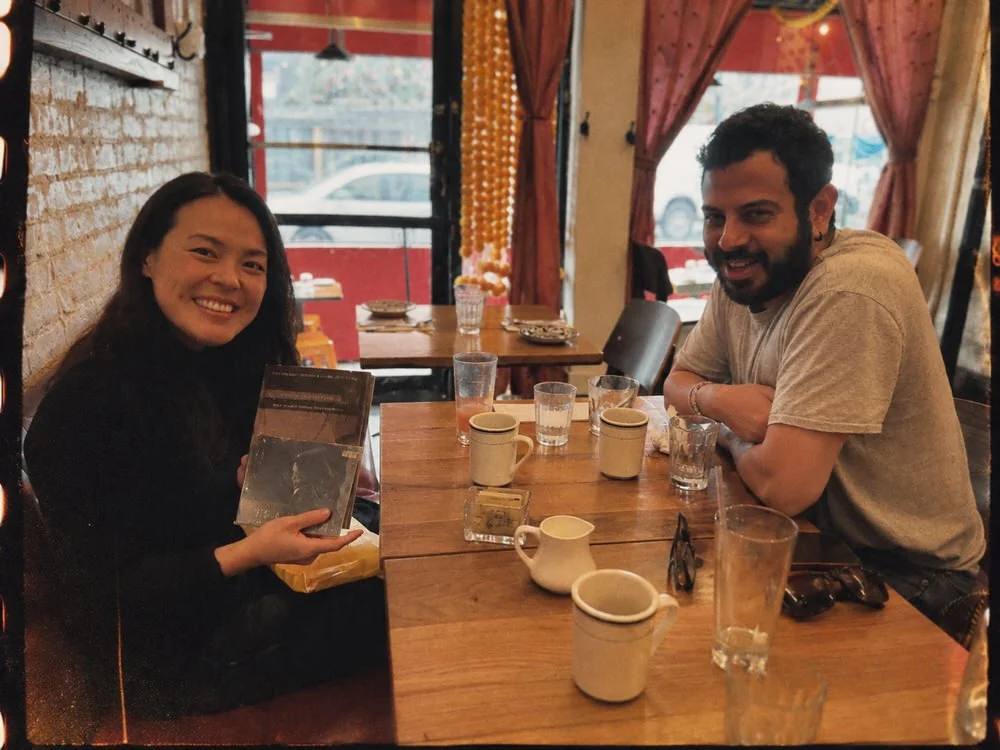
The day after Lavinia Meijer’s concert at Public Records, she and Julián De La Chica met for lunch. During their meeting, De La Chica presented her with two IGM productions: his novel God’s Punishment and The Preludes, an album recorded by pianist Lisa Moore.
Photo by Ilona Miller. Courtesy of the artist’s personal archive.
10. IGM: Your career moves freely between traditions, genres, and artistic forms. What still makes you take risks?
L.M: I think choosing an instrument like the harp was, on the one hand, very difficult because there were no real existing paths to take, but it also created freedom as an artist.
When you create your own path—which in my case is to show all the possibilities of the harp as a solo instrument, to prove that the harp is more than what most people think it is—I can allow myself to experiment back and forth.
It is appreciated by the audience who knows me. Hopefully, somehow, I can also inspire young artists to believe in their childhood dreams.
11. IGM: What would you tell a young musician who refuses to fit into the classical music establishment?
L.M: I do think that becoming an artist means you need to develop yourself in different ways—not only as a performer, but also as a researcher, programmer, producer, audience member, journalist, etc.
It helps build confidence to know a bit about the professions connected to that of a performer. We all need each other.
And never stop believing in yourself.
I often say to students, “Your biggest enemy is your own insecurity.” If you don't believe in yourself, how can the audience believe in you?
When I'm nervous before a performance, I think about how much consolation the world needs, and I'm instantly brought back to the feeling of why I am still an artist to this day.
IGM: Thank you, Lavinia! It's been a pleasure having you with us at IGM Editorial.
* Editorial Note: AI-assisted tools were used for language editing and grammatical refinement. The interviewee's views and intended meaning have been preserved. Final editorial review by IGM Editorial.